Contact foam selected around instrument finish and sensitivity.
Application / Medical
Medical & Lab
Equipment Cases
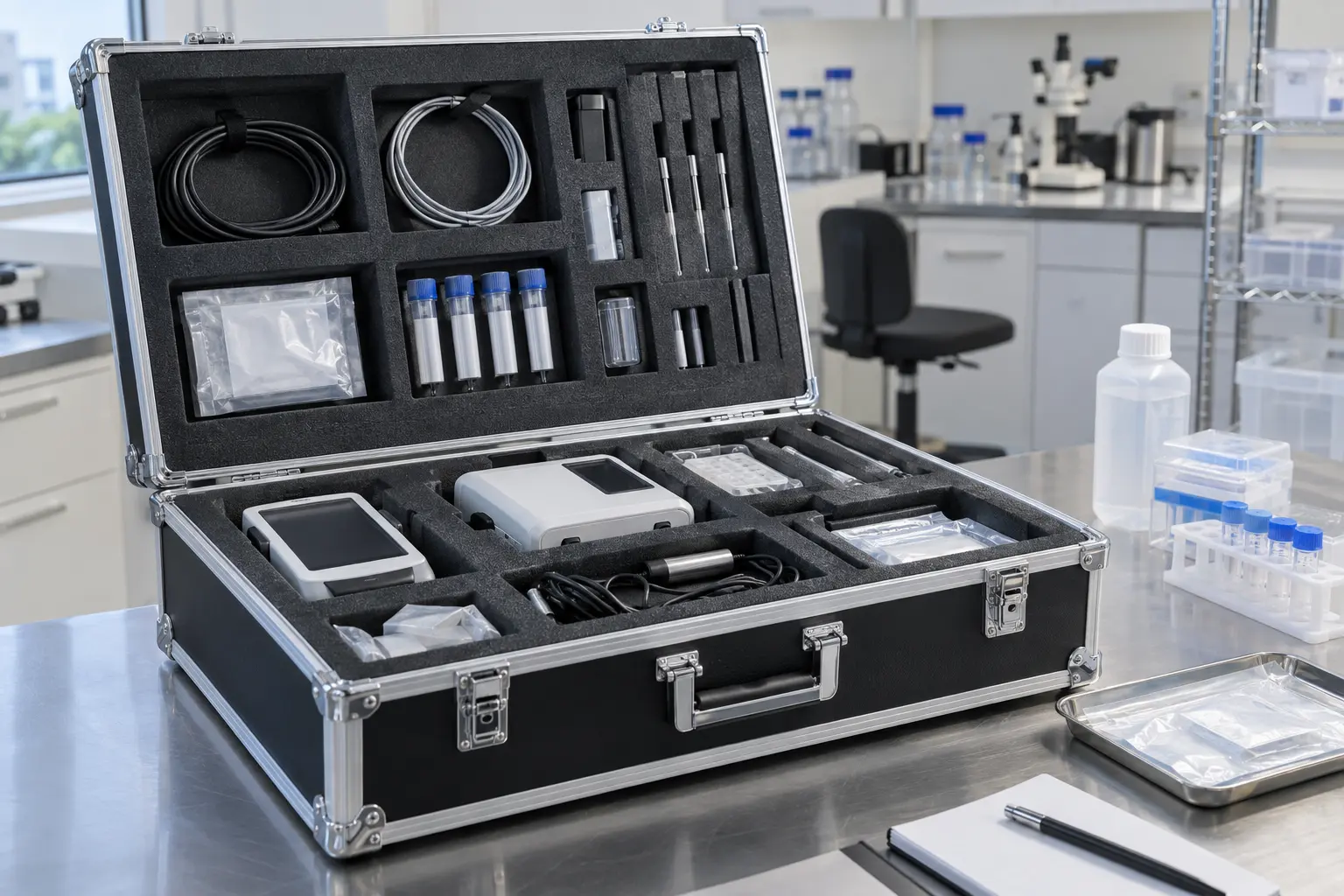
Custom case and foam layouts for instruments, probes, cables and related accessories.
DESIGN PRIORITIES
Start with the equipment and use conditions.
Dedicated positions make missing components easier to identify.
Material and surface requirements must be defined by the buyer.
Project drawings and material information can support buyer review.
CONFIGURATION QUESTIONS
Protection must match the device workflow.
For medical and laboratory equipment, the case design starts with transport and storage needs. Device approval, clinical use, sterilization and regulatory compliance remain controlled by the buyer and the applicable product documentation.
Identify delicate housings, displays, probes and calibrated parts. Foam contact areas, protective films or soft lining can then be reviewed around the actual surface requirements.
State whether the case exterior, removable trays or foam require a particular cleaning method. Standard foam should not be described as clean-room, antimicrobial or sterilizable without material evidence.
Separate spaces can be prepared for cables, probes, consumables and documents so the receiving team can check the kit before and after transport.
COMMON QUESTIONS
Clarify the intended use.
Does the case itself require medical certification?
Not automatically. Requirements depend on the destination, device classification, intended use, material contact and buyer contract. Send any named standard or material restriction before quotation.
Can you provide material and inspection records?
The agreed panel, foam and component information can be listed by project, and pre-shipment photos can record dimensions, fit, hardware operation, finish and packing. Third-party testing is quoted separately.
Regulated use
-
01
State the intended use
Medical-device compliance is not assumed from the case alone.
-
02
Provide material requirements
Cleaning, ESD, flame or chemical needs require an agreed specification.
-
03
Define validation
Test method, sample and acceptance criteria are agreed before testing.
TYPICAL SPECIFICATION
What a medical or laboratory case usually needs.
Standard choice for laboratory equipment because it does not absorb spills and can be wiped down.
Cavity walls are routed cleanly rather than cut, so there is no loose particle shedding around sensitive equipment.
Where the analyser stays on a bench and only the accessories travel, a removable tray or drawer often works better than a single block.
Tubing, cuvettes, probes and calibration tools each get a defined position, which is what prevents them arriving loose.
Benchtop analysers are dense. The base layer carries the weight; the facing only locates the unit.
COMMON MISTAKES
What goes wrong in a medical enquiry.
Open-cell foam absorbs cleaning agents and holds moisture. If the insert will be wiped down, say so and we will match the material.
Protection and certification are separate questions. If a project must meet a specific standard, supply the standard with the enquiry — we will not claim a certification we have not tested for.
Humidity during sea freight matters more than impact for some instruments. Closed-cell material and desiccant provision are the usual answer.
If the equipment comes out for calibration on a schedule, that handling should be designed for.
An insert is designed around the full kit, not the main unit. A late accessory list usually means a second insert.
PRICE DRIVERS
What changes the cost of a medical case.
Closed-cell material for wipe-down environments costs more than standard open-cell and is the correct choice where cleaning agents are used.
Flocked or laminated facing adds a process step but protects both the instrument and the foam over years of use.
Laboratory kits carry many small items. Each routed position is machining time.
A removable tray or drawer assembly adds hardware and additional fitting.
Benchtop analysers are dense. The base layer and restraint for a heavy unit is a specification item, not a margin.
Where a buyer needs inspection records or test documentation against a supplied standard, that work is quoted separately because it is not part of normal production.
QUICK REFERENCE
The medical checklist.
Closed-cell foam in a plywood case, smooth routed cavities, lift-out tray for accessories.
Instrument footprint including any rear connectors, plus the case internal dimensions if you already own the case.
Consumables, tubing, probes, calibration tools and the cleaning regime the insert has to survive.
Does the insert get wiped down or autoclaved, and with what?