Define rack units, usable depth and front/rear clearance.
Application / AV
AV Rack &
Road Cases
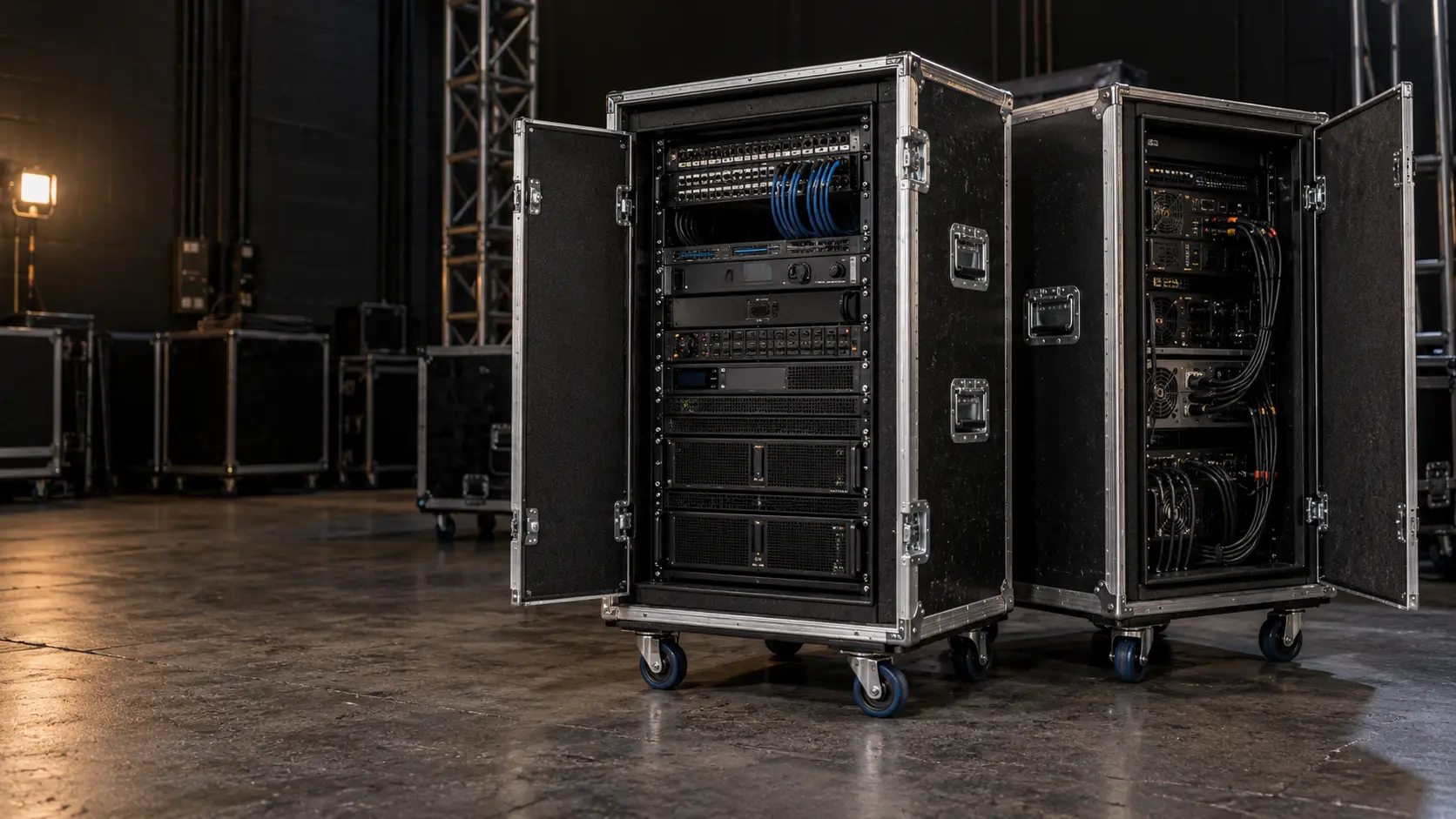
Mobile rack cases designed around rack-unit count, usable depth, cable access, total weight and handling.
DESIGN PRIORITIES
Ready for repeated handling.
Door style and service access planned around the installed system.
Caster type and handle positions matched to total loaded weight.
Openings or fan requirements are confirmed by the equipment integrator.
CONFIGURATION QUESTIONS
Design for transport and operation.
A mobile rack must protect equipment in transit and still provide practical access at the venue. Rack height alone is not enough: loaded depth, rear connectors, cable bend radius, ventilation and center of gravity affect the case.
Provide the rack-unit count, mounting format, usable depth and equipment list. Note any components that project beyond the front or rear mounting face.
Removable lids, hinged doors, cable openings and service panels are positioned around the operating workflow rather than added after the rack is assembled.
Total loaded weight determines handle placement, caster arrangement and whether the case should be moved by one person, two people or handling equipment.
COMMON QUESTIONS
Plan the loaded system.
Can equipment operate while it remains in the rack case?
Yes, when access, ventilation, cable routing and stability are designed for that purpose. Provide heat output and operating-position information so these details can be reviewed.
Are casters included on every rack case?
No. Small cases may use rubber feet or corner wheels, while larger loaded racks often need swivel casters with an agreed braked and unbraked arrangement.
Useful RFQ information
-
01
Rack units and depth
Include connectors and cable bend space.
-
02
Total loaded weight
Required for handling and caster selection.
-
03
Access requirements
Front, rear, side panels, mixer top or removable lids.
TYPICAL SPECIFICATION
What an AV or mobile rack case usually needs.
Enough depth behind the rails for rear connectors and cable bend radius. This is the single most common cause of a rack case that cannot be cabled in the field.
12U, 16U and larger are all built to the same approach: rails positioned so the front panel lines up with the case opening.
Where amplifiers or transmitters are racked, airflow has to be designed in rather than added later.
Caster boards and corner bracing sized for the loaded rack, not for an empty case.
Matched outer dimensions so several cases strap and load as one unit.
COMMON MISTAKES
What goes wrong in an AV enquiry.
Harnessed racks need clearance behind the rails. Measured to the case wall, they will not close.
A rack case often carries a mixer, monitor or antenna above it. That weight changes the specification.
Caster choice follows total loaded weight and the floor surface. Small casters on a heavy rack is the classic failure.
Where a system travels as several cases, the outer dimensions should match so they behave as one load.
Front only, front and rear, or removable front. Each has a different cost and a different crew workflow.
PRICE DRIVERS
What changes the cost of a rack case.
Depth is the expensive dimension in a rack case because it drives panel area and the rear access provision.
A removable or hinged rear door adds hardware and assembly time but is what makes a harnessed rack usable.
Airflow designed into the build costs less than a retrofit and is priced into the specification.
Amplifiers and power supplies are heavy. Caster boards, corners and bracing scale with the load.
Building several cases to matched outer dimensions is a specification decision made at quotation, not an extra.
Rails and mounting hardware are specified with the case, so the front panels line up with the case opening.
QUICK REFERENCE
The rack checklist.
Rack rails positioned to the case opening, rear access, ventilation provision, braced caster boards.
Loaded rack weight, rack units, and the depth needed behind the rails for connectors and cable bend radius.
Whatever sits above the rack, and where the power distribution lives.
Is the rack cabled in the field, or only at the venue?
RELATED
Related information.
Trade terms and typical production windows for rack case orders.
What to send for a rack case drawing, and how approval works.
Representative builds, including a touring rack case.