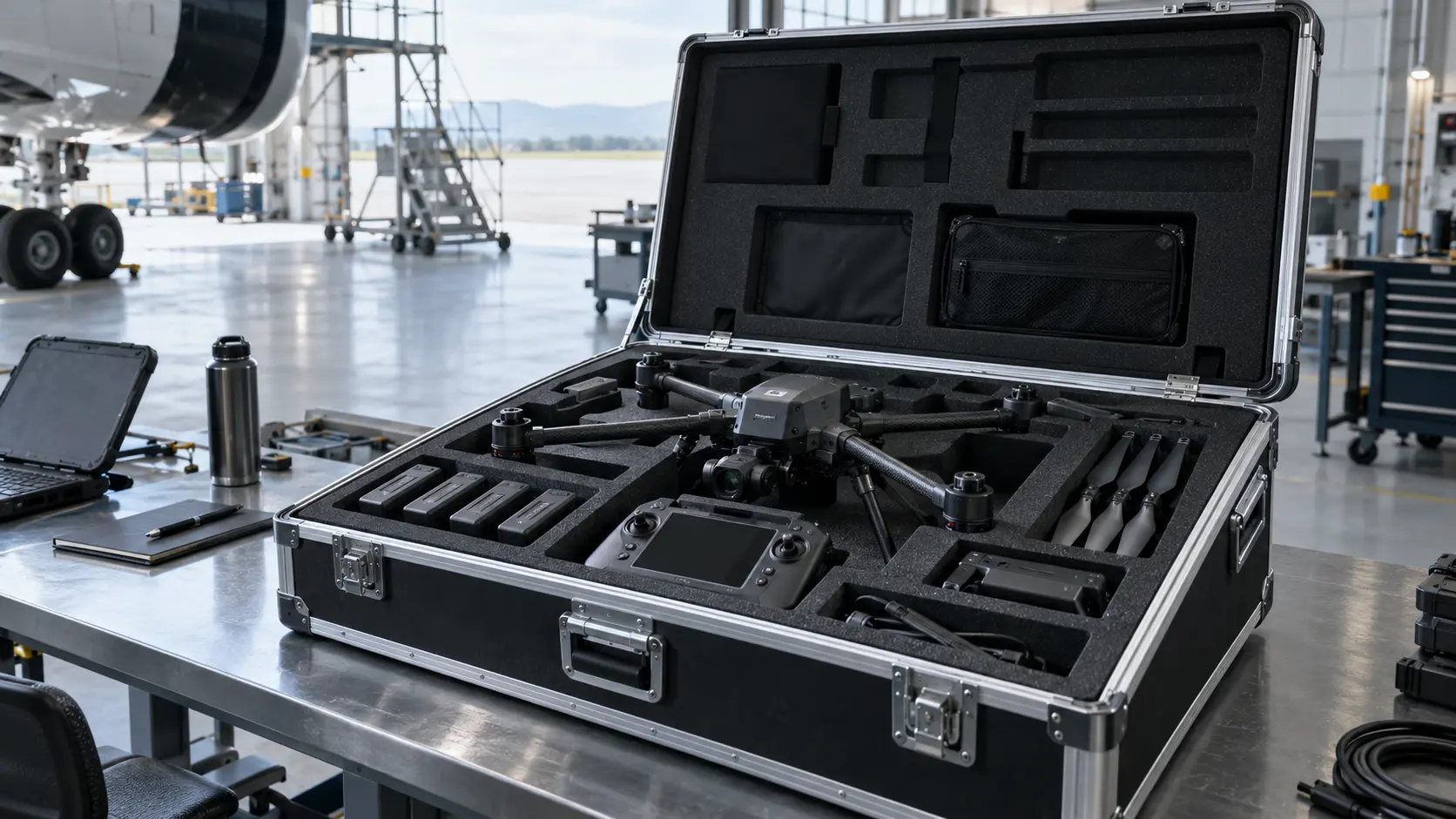
Define each aircraft, controller, payload and accessory position.
Application / UAV
Drone & UAV
Case Systems
A coordinated transport layout for aircraft, payloads, controls, batteries and field accessories.
DESIGN PRIORITIES
Plan the complete equipment set.
Provide dedicated cavities; transport compliance remains the shipper's responsibility.
Finger access, lift points and layer planning for repeated deployment.
Replaceable foam sections or accessory spaces can be discussed.
CONFIGURATION QUESTIONS
Define the transport state before the foam.
A drone may travel assembled, folded or partly disassembled. The chosen state changes the case dimensions, cavity depth, setup time and risk to propellers, antennas, gimbals and connectors.
Identify removable payloads, cameras, antennas and fragile protrusions. Separate cavities can reduce contact between high-value parts during handling.
Battery cavities can be organized and protected from loose accessories, but transport classification, state of charge, labeling and carrier acceptance remain the shipper's responsibility.
Confirm which items must be reached first, whether the lid needs storage, and whether the case will be lifted by one or more people or moved on casters.
COMMON QUESTIONS
Before the first drawing.
Can one case hold the complete UAV kit?
Often yes, but total weight and safe lifting may favor separate aircraft, battery and ground-station cases. We compare packing efficiency with handling risk before fixing the layout.
Can the foam be updated when the payload changes?
Replaceable foam layers or modular sections can be considered when future payload changes are known. Send the current and expected equipment outlines during the design stage.
Useful RFQ information
-
01
Drone model or dimensions
Include folded and operating configuration where relevant.
-
02
Full kit list
Payloads, batteries, controller, charger and field tools.
-
03
Transport method
Road, air freight, storage or repeated field handling.
TYPICAL SPECIFICATION
What a UAV transport case usually needs.
9–12 mm plywood with aluminium profile and ball corners. Panel thickness follows the loaded weight, not the aircraft size — a light airframe with dense batteries still needs a braced caster board.
A routed cradle that carries the airframe without resting it on the landing gear. Gear and gimbal are the parts most often bent in transit.
A separate lined block or tray. Batteries are the densest item in the kit and are the usual cause of a case that looks adequate but handles badly.
Controller, tablet, antennas and cables in their own cavities. If the setup order matters in the field, the layout should follow it.
Where the crew works out of the case rather than repacking it, a lid or front opening configuration is usually worth the extra cost.
COMMON MISTAKES
What goes wrong in a UAV enquiry.
Drones are usually transported folded. If the folded outline is not measured, the case comes back oversized and unusable.
Antennas, gimbal guards, spare propellers and chargers are the items that end up loose in the lid because nobody listed them.
Landing gear is designed for landing, not for the vibration of a loaded case on a road.
It changes the cavity geometry and often the whole layout. Tell us the transport rule you work to.
A case that fits the drone but not the ground station usually becomes a second case, at a higher total cost.
PRICE DRIVERS
What changes the cost of a UAV case.
Panel thickness and caster hardware follow the total kit weight. A light airframe with six battery packs often needs a heavier build than the aircraft suggests.
Each additional machined cavity adds routing time. A single block with eight cavities costs materially more than a shell with two.
PE is the most economical. EVA, XPE and PU cost more and are specified where the equipment surface or the load demands it.
A lid-only case is the baseline. Front opening, removable front and drawer configurations add hardware and assembly time.
Casters, braced caster boards and corner reinforcement scale with the loaded weight. This is the item most often underestimated.
Prototype pricing is not production pricing. A repeat order against an approved drawing removes the design and setup share.
QUICK REFERENCE
The UAV checklist.
Plywood case, aluminium profile, PE base with EVA facing, separate lined battery block.
Folded airframe outline, propeller span with props fitted, ground station and antenna footprint.
Charger, cables, spare props, gimbal guard and the tablet or controller mount.
Will the crew work out of the case on site, or unpack it fully each time?